 Send Email
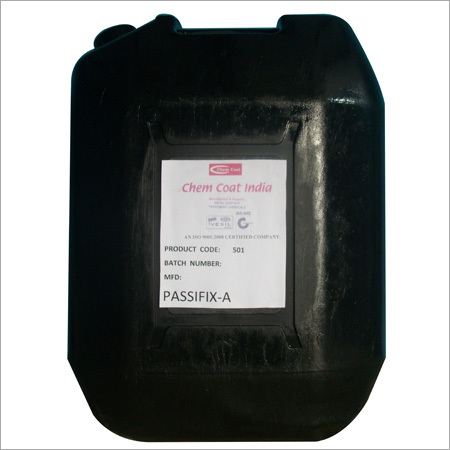
Passifix-a (Passivation) Chemical
Product Details:
- Other Names Stainless Steel Passivation Chemical
- Molecular Formula Proprietary mixture
- Form Liquid
- Structural Formula Proprietary
- Shape Liquid
- Poisonous Yes
- Ph Level <2 (Strongly acidic)
- Click to View more
Passifix-a (Passivation) Chemical Price And Quantity
- 40 Kilograms
Passifix-a (Passivation) Chemical Product Specifications
- 1.10 Gram per cubic centimeter(g/cm3)
- <2 (Strongly acidic)
- Meets ASTM A967/A380/A967M standards
- 99%
- 38101010
- Bitter
- Completely soluble in water
- Passivation of stainless steel and related alloys
- Strong acidic odor
- Above 100C
- Yes
- Industrial
- Liquid
- Surface Treatment Chemical
- Stainless Steel Passivation Chemical
- Proprietary mixture
- Liquid
- Passivation Chemical
- Proprietary
Passifix-a (Passivation) Chemical Trade Information
- Days
- Yes
- Contact us for information regarding our sample policy
- Delhi
Product Description
Passifix-a (Passivation) ChemicalWe have gained immense appreciation among our clients for manufacturing and supplying a comprehensive assortment of Passifix-a (Passivation) Chemical. The chemical is usedto eliminate contaminants from the pretreatment metal surfaces. Specially formulated using premium quality of components, this Passifix-a (Passivation) Chemical is also applied to hexavalent chromium coating in order to avoid attachment of oxides, chlorides etc., present in the air. Our clients can avail these chemicals from us market leading prices.
|
Product Specifications
Product Operating Data
|
||||||||||||||||||||||||||||||||
Reliable Stainless Steel Passivation
Engineered for industrial use, Passifix-a provides thorough and effective passivation of stainless steel and related alloys. By creating a passive, corrosion-resistant surface, this chemical extends the lifespan of metal components and equipment, especially in demanding environments. Its adherence to stringent ASTM standards ensures industrial reliability and lasting results.
Safe and Efficient Application Process
Passifix-a is supplied as a strong acidic liquid and must be handled with protective gear due to its corrosive nature. The application process involves complete cleaning, immersing or circulating the solution, and rinsing, resulting in the removal of contaminants and enhanced metal protection. Use in well-ventilated areas, following the manufacturers guidelines, for optimal safety and efficiency.
FAQs of Passifix-a (Passivation) Chemical:
Q: How should Passifix-a be applied during the passivation process?
A: Passifix-a should be applied after thoroughly cleaning the metal surface. Immerse or circulate the solution over the stainless steel or alloy surface as per recommended procedure, ensuring complete contact. After the required dwell time, rinse the treated parts thoroughly with water to remove residual chemicals.Q: What benefits does Passifix-a offer for stainless steel components?
A: Passifix-a effectively removes contaminants like free iron and oxidation, restoring the chromium-rich passive layer on stainless steel. This significantly increases corrosion resistance, prolongs equipment life, and maintains a clean, lustrous surface finish in industrial environments.Q: When is Passifix-a recommended for use?
A: Passifix-a is recommended whenever stainless steel or allied alloy surfaces require passivation, for example, after fabrication, welding, or machining. Routine passivation ensures optimal corrosion resistance for equipment used in critical industries.Q: Where can Passifix-a be used?
A: Passifix-a is suitable for industrial settings such as manufacturing plants, fabrication workshops, and facilities handling stainless steel equipment. It is widely used in pharmaceutical, food processing, chemical, and engineering sectors across India.Q: What is the appropriate usage protocol for handling Passifix-a?
A: Due to its strongly acidic and corrosive nature, Passifix-a must be handled with suitable protective equipment, including gloves, goggles, and chemical-resistant clothing. Perform application in a well-ventilated setting and follow all safety instructions provided by the manufacturer.Q: How does Passifix-a meet quality and safety standards?
A: Passifix-a meets ASTM A967, A380, and A967M standards for stainless steel passivation. Its high purity and proprietary formulation ensure consistent results, while strict adherence to safety protocols guarantees both user safety and environmental compliance.
Price:
- 50
- 100
- 200
- 250
- 500
- 1000+

Other Products in 'Industrial Chemicals' category



Branch office
Village Gullarwala, Sai Road,
Near Vishal Mega Mart, Baddi (H.P)
Mobile No.: +918894293302, +919811140231, +919999324696
GST : 06AKNPS6094D1ZR

- Plot No. 487, Sector- 58, Faridabad - 121004, Haryana, India

- Mr. Rajesh
- Mobile :08045479828
- Branch Office : Village - Gullarwala, Sai Road ,Near Vishal maga mart, Baddi (HP)

Developed and Managed by Infocom Network Private Limited.
